
Guru Purnima : Celebrating the Guiding Light of Our Lives
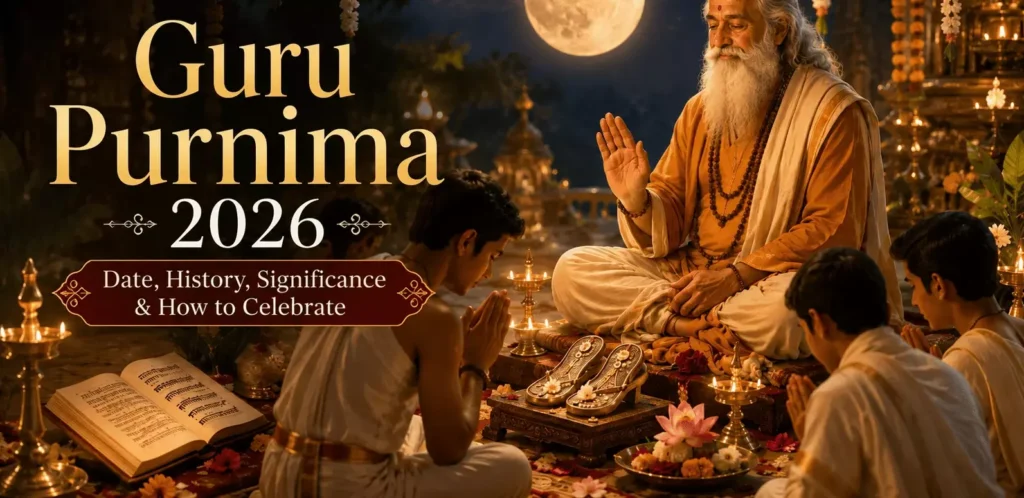
1. Why is Guru Purnima Celebrated ?
In India’s cultural traditions, there are certain festivals whose significance is not merely religious but deeply spiritual, moral, and humanistic. Guru Purnima is one such wonderful celebration—a day dedicated to the light of knowledge, the glory of guidance, and the spirit of gratitude. This festival is not just an occasion for rituals but a symbol of respect toward those pillars of life who have inspired us to think, understand, and walk in the right direction.
Table of Contents
ToggleThis day, celebrated on the full moon of the Hindu month of Ashadha, has been beating in the heart of Indian civilization for centuries. On this day, disciples express reverence toward their gurus, seek blessings, and introspect on how well they are following the guru’s teachings.
Guru Purnima is an extremely significant festival in Hindu, Buddhist, and Jain traditions. It is not only a symbol of the guru-disciple tradition but also a celebration of knowledge, spiritual contemplation, and religious life. This day is observed on the full moon day (Purnima) of the Ashadha month, which falls around mid-July according to the modern calendar. Through this festival, we honor our gurus—whether teachers or spiritual guides—and express gratitude for their life-giving contributions.
2. The Meaning and Significance of the Guru
The word ‘guru’ is deeply profound in itself. In Sanskrit, ‘gu’ means darkness and ‘ru’ means the one who dispels it. That is, a guru is one who dispels the darkness of ignorance and spreads the light of knowledge. A guru is not merely a teacher who provides academic knowledge but a personality who gives direction to life.
In life, parents give us birth, but a guru gives us character. A guru does not just provide subject knowledge but teaches us how to remain patient in difficult situations, how to walk the path of truth, and how to recognize the potential within ourselves.
In Indian tradition, the guru is placed even higher than God—
“गुरुर्ब्रह्मा गुरुर्विष्णु गुरुर्देवो महेश्वरः ।
गुरुः साक्षात् परं ब्रह्म तस्मै श्रीगुरवे नमः ॥”
This verse shows that the guru symbolizes the three powers—creation, preservation, and destruction.
3. Guru Purnima Date and Time Cycle
According to the Vedic calendar, the full moon date will begin at 6:19 PM on July 28, 2026, and end at 8:06 PM on July 29, 2026. Based on the rising date and scriptural beliefs, the festival will be celebrated on July 29.
4. Historical and Mythological Basis
(A) Maharshi Vedavyasa Festival
Maharshi Vedavyasa is one of the compilers of the Vedas, the author of the Mahabharata, and the spiritual bestower of the Bhagavad Gita in Hindu tradition. He was born on the full moon day of Ashadha, which is why this day became renowned as Guru Purnima. Vedavyasa divided the Vedas into four compilations—Rigveda, Yajurveda, Samaveda, and Atharvaveda; compiled the Mahabharata and the Puranas; and gave the Bhagavad Gita its textual form, creating an ocean of knowledge.
(B) Significance in Buddhism
In Buddhism, this day is celebrated as “Dhammachakra Pravartan Day.” This was the day when Lord Buddha gave his first sermon—”Dhammachakra Pravartan”—to five ascetics (the Pancha Sangha) at Sarnath. Through this sermon, the foundation of Buddhism was laid. This is another reason why this date is significant as Guru Purnima.
C) The Guru-Disciple Tradition in Jainism
In Jainism, on this day, initiation and teachings are imparted by the great monastic leaders and acharyas. The role of gurus is considered extremely important among Jain monks and preachers, so this day is observed with widespread respect and reverence.
5. Religious and Social Significance
(A) Guru-Disciple Relationship
Indian history offers countless inspiring examples of guru-disciple relationships. Krishna-Sandipani, Rama-Vashishtha, Chanakya-Chandragupta, Ramakrishna-Vivekananda—these relationships were not limited to education but were examples of life-building. The guru-disciple bond is based on trust, discipline, and respect. The guru imparts knowledge, but it is the disciple’s duty to embody that knowledge in conduct.
(B) Gratitude and Reverence
On this day, disciples express their gratitude toward the guru. Thanks are offered for the guidance, teachings, and outcomes that the guru has provided in life. Offerings such as dakshina, flowers, books, clothing, or service are presented to the guru.
(C) Mental and Spiritual Growth
The festival of Guru Purnima brings an opportunity for spiritual progress. On this day, luminous meditation practices, mantra chanting, and instructive discourses take place.
(D) Unity Across Ordinary and Diverse Sects
This festival is enthusiastically observed by three major traditions—Hindu, Buddhist, and Jain. People of various religions become mindful of the spiritual journey of knowledge on this day.
(E) The Philosophical Form of the Guru
In Indian thought, the guru has not been viewed merely as a teacher but as a guide who awakens consciousness. A true guru:
Does not hand over answers to the disciple but teaches them to ask questions
Develops self-reliance, not dependence
Awakens courage, not fear
The guru’s purpose is to help the disciple discover their own personality. The guru inspires one to understand the meaning of life, not just to follow rules. There are few people in life who honestly point out our mistakes. The guru’s role is not only to inspire but also to correct.
Sometimes the guru’s teachings may seem harsh, but their purpose is always benevolent. Just as gold is refined by heating, similarly, the guru polishes the disciple’s personality.
Over time, the form of the guru has changed. Sometimes the guru appears as an acharya, sometimes as a teacher, and sometimes as a silent motivator.
There are many gurus in life:
Parents — who are the first teachers of life
Teachers — who provide knowledge and skills
Experience — which teaches real life lessons
The Soul — which gives the sense of right and wrong
Guru Purnima inspires us to express gratitude toward all of them.
6. Rituals: Basic Steps
(A) Bath and Ceremonial Adornment
On Guru Purnima, unmarried men wear simple white garments. After bathing in the morning at an auspicious time, the ritual altar is arranged following purification.
(B) Lighting the Lamp
A lamp is lit before the guru’s picture, statue, or idol. The lamp symbolizes the transition from ignorance to knowledge.
(C) Flowers and Pranayama
Fresh flowers, unbroken rice (akshat), fruits, coconut, honey, jaggery, sandalwood, etc., are offered with symbolic reverence. In some sects, pranayama and mantra chanting are also included.
(D) Chanting Guru Mantras
The famous mantra “Om Gurur Brahma Gurur Vishnu Gurur Devo Maheshwarah” is chanted. In addition, guru shlokas, sutras, or tantric mantras related to personal gurus are also recited.

(E) Guru Dakshina
As guru dakshina, some money, books, clothing, or service is typically offered. This deepens the bond of guidance between guru and disciple.
(F) Bhajans and Kirtans
At many places, kirtans, bhajans, and discourses are organized. Everyone becomes enchanted, listening to devotional and knowledge-filled words with reverence.
7. Observance and Administration
(A) Monastic Orders and Ashrams
Special assemblies are held in ashrams and monastic orders. Gurus impart knowledge, discourses, and teachings to their students.
(B) Schools and Universities
Educational institutions—schools, colleges, universities—organize events on this day. Students express gratitude for the guidance provided by their teachers.
(C) Social and Spiritual Organizations
Yoga, meditation, knowledge centers, religious assemblies, and spiritual institutions also organize satsangs, lectures, workshops, etc., on this day. Almost all centers focus on guru darshan, shlokas, and topics of righteousness.
8. Fasting, Charity, and Philanthropy
(A) Fasting
Devotees observe a fast on the full moon of Ashadha. Some eat fruits, while others observe a waterless (nirjala) fast. Fasting purifies the mind and brings an experience of physical divinity.
(B) Charity
Charity is given in three ways:
Food donation (Annadan)
Clothing donation (Vastradan)
Education donation — providing educational materials to underprivileged children
According to tradition, charity and meritorious acts performed on Guru Purnima are highly fruitful.
9. Declarations by Scholars and Gurus
On Guru Purnima, renowned gurus and spiritual preachers deliver discourses. They give profound talks on the significance of Guru Purnima, the guru-disciple relationship, psychology, and the spiritual path.
10. Contemporary Context
(A) The Guru-Teacher in the Digital World
Today, educational gurus have become school streaming videos, mobile apps, online platforms, etc. Traditional guru-disciple association remains unparalleled—the place of a guiding guru remains distinct compared to teachers in name only.
(B) Constitutional and Social Respect
Many countries regard Guru Purnima as Teachers’ Day. On social media, guru reflections, poems, and inspiring videos are shared with the #Gurupurnima tag.
(C) Global Recognition
Apart from India, communities following the Buddhist path in Nepal, Sri Lanka, Burma, Thailand, Cambodia, Japan, and other countries celebrate it. In these countries, special spiritual seminars, meditation sessions, and meditation camps are organized on this day.
11. Personality Analysis
(A) The Form of the Guru
The guru’s form is depicted in three aspects:
Brahma-guru — the creator
Vishnu-guru — the preserver
Maheshwara-guru — the destroyer (of worldly ignorance)
(B) The Role of the Disciple
The disciple’s duty is to show loyalty, dedication, reverence, and conduct in accordance with the guru. The guru-disciple relationship should be based on trust and conduct.
| Aspect | Details |
|---|---|
| Festival Date | Ashadha Purnima (falls in July) |
| Significance | Guru-disciple tradition, Maharshi Vedavyasa, Buddha’s sermon (Dhammachakra Pravartan) |
| Main Activities | Ritual worship, mantra chanting, lamp lighting, guru dakshina, bhajan-kirtan |
| Fasting and Charity | Waterless/fruit fasting, food donation, clothing and education charity |
| Modern Association | Events in educational institutions, digital platforms, social media activities |
| Global Impact | Meditation camps in Buddhist countries, guru gatherings, global guru recognition |

12. Global Perspective
Traditions of gurus exist in other cultures as well—such as the Japanese Sensei, Chinese Master, Christian Pastor, etc.—whose role is the same: to impart knowledge and guidance. The festival of Guru Purnima essentially embodies the global idea of mentors and coaches.
13. Personal Discipline
The most beautiful message of Guru Purnima is—learn to express gratitude. We learn from many people in life but often forget to thank them. This festival reminds us that gratitude is not merely etiquette but a great human virtue. Seeing the emotion of gratitude in the eyes of your guru or role model after meeting them is a life-changing experience. Guru Purnima inspires us to walk the path of our ideals.
14. Conclusion
Guru Purnima is not just a religious festival; it is an opportunity to reflect on the importance of life’s guides, express gratitude toward our sources of knowledge, and gain new energy and inspiration for spiritual progress. Hinduism, Buddhism, and Jainism—through this festival, all three traditions teach us that the guru’s role in human life is supreme.
Guru Purnima is not merely about “attaining a guru” in the sense of teaching, guidance, and spiritual growth; it is a celebration of inner transformation, expansion of consciousness, and offering humanity a savior. Let us commit ourselves on this day—the youth of the future, students, parents, and gurus:
“A guru is not just a name, but a light – victory over the darkness of ignorance, the life-force of the world of wisdom, and the unbroken saga of consciousness.”
Heartfelt wishes to all of you on Guru Purnima! Although I am writing in just a few words, this salutation comes from the vast ocean of guru-reverence that cannot be bound in words.
15. Suggestions
Make this Guru Purnima more meaningful with the following activities:
Write personal letters to your gurus
Connect with gurus via online video conference
Organize dignified events in educational institutions
Donate food and clothing to the underprivileged
Listen to meditation, prayers, or online discourses
On this sacred occasion of Guru Purnima, we all should pay tribute to our respective gurus with listening, reverence, and dedication. Their guidance alone awakens us and leads us toward an ideal life. May Guru Purnima be auspicious.
People Also Ask (PAA)

1. Is Guru Purnima still relevant in modern times?
Ans) Yes, even today, the guru-disciple relationship remains the foundation of inspiration and guidance. This day reminds us of learning and expressing gratitude.
2. Are only saints and sages gurus, or can anyone teach me something?
Ans) Absolutely not! A guru is not just someone who makes you sing bhajans. A guru is someone who changes the framework of your thinking. If your office senior manager taught you leadership, your mother taught you patience, or a friend taught you self-respect—they are all gurus. Guru Purnima is a day to say thank you to all visible and invisible teachers.
3. I don’t have a physical guru—whom should I remember?
Ans) On this day, you can make your past mistakes your guru. Yes, it may sound strange, but the thing that gave you the most pain also taught you the most. Salute that pain on this day and resolve that you will not repeat that mistake. That is the greatest guru dakshina.
4. Should a disciple always agree with the guru?
Ans) Absolutely not! A true guru challenges you and does not flatter you. If someone always praises you, they are not a guru but a mirror. On this day, also remember those who told you bitter truths, even if it hurt at the time.
5. Is it enough to post “Happy Guru Purnima” on social media?
Ans) That is just a status. Real tribute is when you follow the path shown by the guru. If your guru taught you to wake up early, then wake up early today and show it. If they taught you honesty, then speak a small truth today. Practical guru dakshina is the real dakshina.
6. If I don’t have anyone to call “guru” today, am I alone?
Ans) Absolutely not. On this day, you can consider books as your guru. Decorate the book that changed your life (whether a self-help book, biography, or novel) and re-read a page. Or you can even consider Google/YouTube as your guru—which taught you thousands of things selflessly.
7. What is the most unique thing I can do on Guru Purnima?
Ans) Become someone else’s guru! Yes, today, do something you have learned from someone and teach it to someone else for free—whether it’s copy-pasting, embroidery, coding, or just a good thought. The donation of knowledge is the greatest respect.