
Jagannath Rath Yatra – The Divine Journey of the Lord
Hello Friends, this time the Rath Yatra will be celebrated from July 16 to July 24. It is a magnificent festival in which the Lord Himself comes to meet His devotees. So, in this article, let us together explore every shade of the Rath Yatra—its history, science, devotion, society, and its impact on the human heart—very closely. This is not just a journey. It is a procession of India’s cultural consciousness that has been continuing for thousands of years. So, let us begin this journey—
Table of Contents
Toggle1. Rath Yatra – When the World Stands Still and the Gods Move Forward
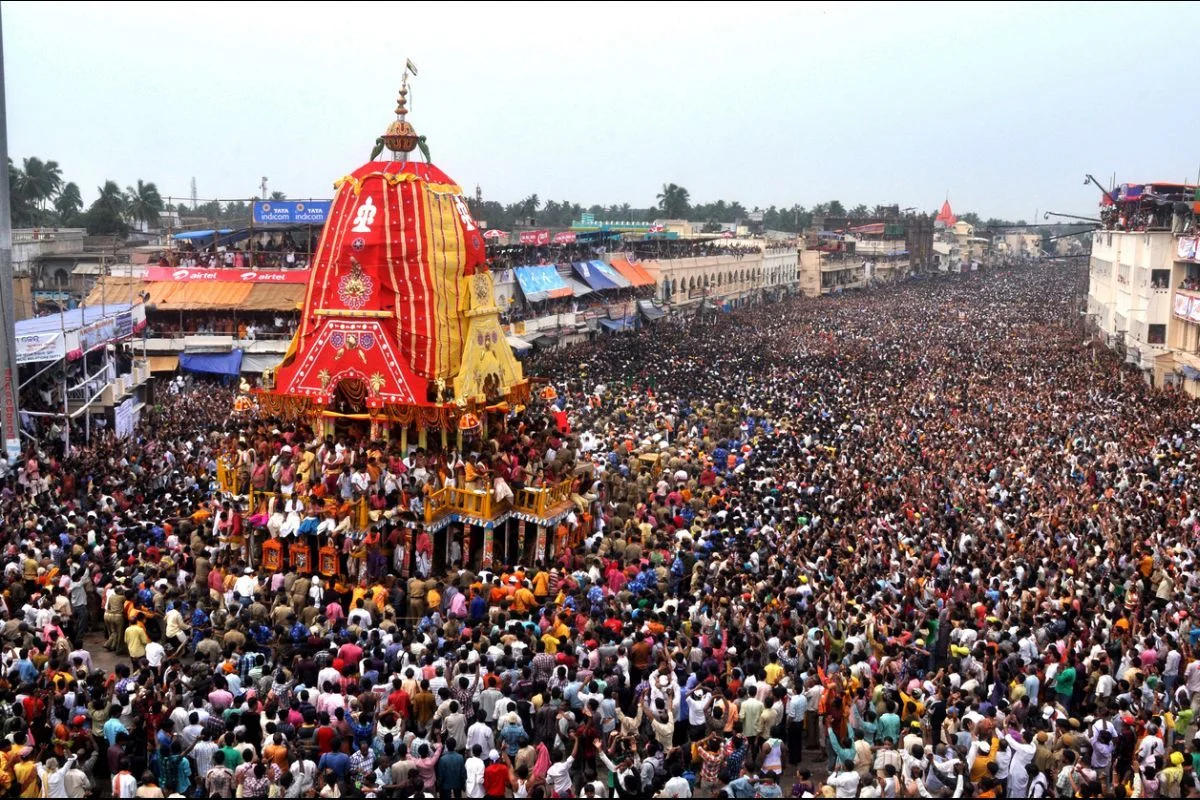
As a child, I never truly understood the Rath Yatra. I used to think that gods live in temples, sit on thrones, we bow our heads before them, and then we return. But when I first went to Puri—I must have been about nine or ten years old—I was stunned. I saw three gigantic chariots standing on the road. People were holding ropes and dragging the gods? This was completely different from the image of God I had in my mind.
I asked my grandfather, “Why are they pulling God?” He laughed and said, “Son, they are not pulling; they are moving among their devotees. The chariot is just an excuse. The real thing is—God has left His throne and is now roaming every street, blessing everyone. Those who cannot come to meet Him, God Himself goes to them.”
That day I understood that the Rath Yatra is not just a tradition. It is a message. It is a celebration of humility. It is a festival of renouncing ego. It is spirituality brought to the streets.
2. Why a Chariot ? Why a Journey ? Exploring the Mythological Origins
The story of the Rath Yatra takes us directly to the Dwarka period of Lord Krishna. It is said that once, the sage Narada told Lord Jagannath (who is a form of Krishna) that, “O Lord, You have given countless visions, but You have never taken Your elder brother Balarama and sister Subhadra out with You anywhere.” Krishna smiled and said, “You have spoken rightly. I have seen Mathura, Dwarka, and Vrindavan, but my brother and sister also wish to see the world.”
Then He said, “Build a chariot and organize a journey where I, my brother, and my sister—all three of us—travel together.” But why the Gundicha Temple? Another legend says that Queen Gundicha (a devotee of Jagannath) prayed, “O Lord, why do You remain only in the temple? Please come to my home as well.” Then the Lord said, “Alright, every year I will come to your temple (now called the Gundicha Temple) for nine days.”
Another profound interpretation exists. It is said that this journey symbolizes the journey when Mother Yashoda sent Krishna and Balarama from Nandgaon to Mathura on a chariot. But they were not prisoners on the chariot—they were smiling, waving their hands. This is the Rath Yatra—a freedom where God Himself comes to the open streets among His devotees.
I often wonder—is this all just a story? Or is there some deeper truth hidden in it? Perhaps our ancestors understood that God cannot be confined within four walls. He is present on every street, every intersection, and every kitchen where a mother feeds her child.
3. The Temple of Puri and the Mystery of Daru Brahma
Before understanding the Rath Yatra, we must understand the Jagannath Temple of Puri. It is no ordinary temple. It is one of the four Dhams—Badrinath, Dwarka, Rameshwaram, and Puri. But Puri is different. The deities here are made of wood—known as Daru Brahma. And their tradition is unique.
It is said that once, Lord Krishna told King Indradyumna in a dream that there is an enormous tree on the seashore. Use its wood to make the idols. The king searched and found it. But there was no one to carve them. Then an elderly carpenter arrived—and he was none other than Vishwakarma himself. He set a condition: “Keep the door closed until I finish. No one should enter.”
Days passed. The king lost patience. He opened the door. The carpenter disappeared. And the idols remained unfinished—without hands and feet. But the king was blessed that these very unfinished idols would be worshipped. And the mysterious power—Daru Brahma—would reside in them.
Whether this story is true or imaginary is debatable. But it is true that the idols of Jagannath, Subhadra, and Balarama in Puri are replaced every 12 or 19 years. And the remarkable thing is that the old idols are secretly buried in a deep pit. No one knows where they are. That place is called ‘Koili Vaikuntha.’
When I first learned that the gods are made of wood, I was surprised and thought—is this superstition? But then I thought—every tradition of giving form to God has a sense of locality, materiality, and humanity. A wooden god is the closest—it burns, it doesn’t dissolve, but it rides on a chariot.
4. Three Chariots, Three Deities, Three Philosophies
At the start of the Rath Yatra, there are three chariots. They are the largest, most colorful, adorned with cloth, stones, bells, and flowers. This is not just a chariot—it is a moving temple.
(A) The First Chariot – Nandighosha (Lord Jagannath's Chariot)
This is the largest and tallest chariot. It has 16 wheels. Its colors are yellow and red. Yellow is the color of knowledge, and red is the color of energy. The name of this chariot is ‘Nandighosha’—Nandi meaning bliss, Ghosha meaning sound. That is, the sound of bliss that resonates throughout the universe. The height of this chariot is about 45 feet. There are stairs to climb it. At the top sits Lord Jagannath—with large eyes, no hands, but a smile that never fades.
(B) The Second Chariot – Taladhwaja (Lord Balarama's Chariot)

This is slightly smaller, with 14 wheels. Its colors are green and red. Green symbolizes nature and agriculture. Balarama is called the wielder of the plow. His chariot bears the symbols of a plow and a pestle. If Jagannath is the god of knowledge, Balarama is the hero of strength and agriculture-based society. The name of this chariot is ‘Taladhwaja’—Tala meaning the palm tree, which symbolizes strength.
(C) The Third Chariot – Darpadalana (Goddess Subhadra's Chariot)
The smallest, with 12 wheels. Its colors are black and red. Black represents mystery and the unknown. This chariot belongs to sister Subhadra. Darpadalana means—the destroyer of ego. This chariot teaches us how important the sister’s place is. In Indian tradition, Raksha Bandhan celebrates the love between brother and sister, but in the Rath Yatra, Subhadra walks between her two brothers—this is balance.
I once asked an elderly priest, “What is the significance of these colors?” He said, “Son, see—Jagannath is yellow like the sun. Balarama is green like the earth. Subhadra is black like the sky. Together, the three sustain creation.”
5. The Art of Chariot Making – Where Wood Comes Alive
No factory makes the chariots. They are made by the Maharana family. This tradition has continued for hundreds of generations. These people live in a small village near Puri. They have not been taught by any IIT. They know neither CAD design nor engineering mechanics. But the strength and design of the chariots they build leave engineers amazed.
There is an ancient method for selecting wood for the chariots. They use wood from specific trees—such as Phasi, Dhaora, and Asan. The wood is dried, no nails are used, and everything is built with pegs and joints. On Akshaya Tritiya, the resolution for chariot construction is made, and then work continues continuously.
I have heard that the wheels of the chariots have no nuts or bolts. They are made of wood. And these chariots are so heavy that thousands of people are needed to pull them. Yet, these chariots do not break until the journey is complete. There was a year when the wood became wet due to rain and the chariot could not move. But the very next day, the sun came out and the chariot moved.
A friend of mine who lives near Puri told me that the Maharana family members do not speak to anyone while building the chariots. They observe a vow of silence. Because they understand that this is not just a vehicle—it is itself a deity.
6. From Snana Yatra to Rath Yatra – The Days When the Gods Fall Ill
This sounds very strange—God falls ill? Yes, in Puri’s tradition, this is believed. On the full moon day of Jyestha, the ‘Snana Yatra’ (Bathing Festival) takes place. The three deities are bathed with water from 108 pots. This bath is so grand that people come from far and wide to witness it.
But from the very next day, the deities go into ‘Anasara’—that is, they fall ill. It is believed that after bathing in such cold water, they catch a cold and fever. For the next 15 days, no one can have their darshan. The temple doors remain closed. Only the royal physicians attend to them. They are offered special medicines, milk, and fruits.
After 15 days, the day of ‘Navayauvana’ (Rejuvenation) arrives. Then the deities are adorned in a new form, as if they have recovered and become fresh again. The very next day, the Rath Yatra takes place.
Looking at this tradition, I feel that our ancestors did not think of God as a harsh, punishing ruler. They considered God a member of the family—one who falls ill, is cared for, takes holidays, and goes on outings. This relationship is not based on fear but on affection.
7. Chera Pahra – When the King Sweeps the Ground
A day before the Rath Yatra, the ‘Chera Pahra’ ceremony takes place. The very mention of this word creates a stir in Puri. ‘Chera’ means to touch, and ‘Pahra’ means to guard. But in reality, it is a ritual in which the Gajapati King (the traditional king of Odisha) sweeps the chariot of Lord Jagannath with a broom.
Taking a golden broom, the king himself walks around the chariot and cleans the path while sprinkling water. This ritual signifies that even the greatest ruler must bow down before God. This is not a political display—it is the essence of humility.
When I was first stunned to learn that a king sweeps the street, my father said, “This is India. Here, the king is also a servant, and the servant is also a king.”
In today’s era, when leaders plaster their photos on the streets and erect statues of themselves, this ritual teaches us that power is temporary, but service is eternal.
8. The Day – When the Chariot is Pulled and Eyes Grow Moist

The main day of the Rath Yatra—Ashadha Shukla Dwitiya. The city of Puri transforms overnight. There is no space to walk in any lane. Everywhere, devotees clad in yellow garments, sandalwood paste on their foreheads, and ropes in their hands. Elderly people, young people, children sitting on shoulders—every face bears the same expression—a unique enthusiasm on the verge of madness, yet completely sacred.
In the morning, ‘Pahandi’ takes place—the deities come out of the temple and climb onto the chariots. This sight is incredible. Drums, kettledrums, conch shells, bells. Devotees chant ‘Jai Jagannath.’ And then…
And then the king arrives. Performs the Chera Pahra. Then the rope is pulled.
Now this rope is no ordinary rope—it is thick, strong, and silken, touched by millions of hands. I have seen with my own eyes that when the chariot moves for the first time, people begin to cry. They don’t just cry—they sob uncontrollably. Because they feel that God has heard their call. God has descended onto the streets just like them.
I recall the Rath Yatra of 2014, where an elderly woman stood beside me. Her hands were trembling. The rope was slightly beyond her reach. I handed her the rope. She touched it and closed her eyes. A minute later, when she opened her eyes, she said, “Son, now I can die in peace. Jagannath has given me His darshan.”
That day I understood that the Rath Yatra is not just a festival—it is the most significant date in the lives of millions of people.
9. Gundicha Ghar – When the Lord Visits His Aunt's Home
When the chariot reaches the Gundicha Temple, it is called ‘Gundicha Ghar.’ It is believed that Queen Gundicha was Lord Jagannath’s maternal aunt. So this journey is like visiting the aunt’s home. Here the deities rest for nine days. These nine days bring a different kind of joy to Puri. Every day there is some special ritual—Sunavesha (adornment with gold and silver ornaments), Adhara Pana (offering of milk and cream), Ratha Bankan (slightly tilting the chariot).
But the most important day is the Bahuda Yatra—the return journey. On the ninth day, the chariots are pulled again, but this time a little hurriedly, because the deities wish to return to their main temple. On the return, a tableau of ‘Rasa Lila’ is taken out. It is believed that rain on the day of Bahuda Yatra is highly auspicious. Many times it has been observed that as the chariots return, clouds suddenly gather and a light drizzle begins. Devotees say—”Look, the gods are crying, remembering their temple.”
10. The Scientific Perspective – What is the Hidden Meaning of This Journey?
When we view the Rath Yatra purely from a religious perspective, some dismiss it as superstition. But if we look at it through the lens of social science, psychology, and ecology, it reveals itself as a remarkable system.
First – The Creation of Collective Consciousness
For thousands of years, this has been happening on the same day, in the same way. It creates a unique social bond. An Odia person, even if in America, is mentally in Puri on that day. It weaves the community into a single thread.
Second – The Breakdown of Class Distinctions
On the day of the Rath Yatra, no one asks about caste, no one sees high or low. On the rope, everyone’s hands are the same—wet with sweat, sometimes stained with blood (when the rope chafes). A Brahmin and a Dalit pull together side by side. This is the greatest equality predating any constitution.
Third – The Economic Dimension Linked to Agriculture
The Rath Yatra takes place in the month of Ashadha. This is the time when sowing has been completed in the fields and the harvest is still some time away. That is, farmers have some free time. That emptiness is filled with celebration so that mental stress is avoided. Additionally, trade, charity, and food distribution—this is an economic cycle.
Fourth – Environmental Balance
The chariots are made entirely of wood, sourced from specific trees. New chariots are built every year, and the wood from the old chariots is used for other temple work or as fuel. This is a sustainable tradition.
11. Mahaprasad – Where the Lord Himself Cooks, and We Eat
Another remarkable tradition of the Rath Yatra is ‘Mahaprasad.’ The kitchen of the Jagannath Temple in Puri is one of the largest kitchens in the world. It is said that food is cooked in seven large pots here, and all of them cook simultaneously—the top pot cooks first, then the one below. It is a scientific marvel how the food in all seven pots gets cooked at the same time. The cooks say—”It is the Lord’s will.”
On the day of the Rath Yatra, this Mahaprasad is distributed. Dry rice, chhana, kheer, dalma, bara, pitha—countless dishes. No one goes hungry. I have seen foreigners, destitute people, beggars—all sitting in the same row and eating from the same plate. This teaches that food is not just for filling the stomach—it is for connecting souls.
12. Tragedies of the Rath Yatra – When the Crowd Becomes a Mother and Also a Bandit
Every year, millions of people come to the Rath Yatra. Sometimes it turns into terror. There was a stampede in 1885, many people were crushed in 1969, and a major accident also occurred in 1990. But the surprising thing is that the Rath Yatra never stopped. Each time, the arrangements improved. Now there are police, NDRF, medical teams, CCTV cameras—everything is in place.
But an interesting thing—incidents of theft and robbery become almost zero on the day of the Rath Yatra. I asked a police officer, “How is this possible?” He said, “Sir, even the thief doesn’t steal on this day. Because he feels that if I stop Jagannath today, it won’t be good for me.”
That is, not fear, but reverence—that too is a form of order.
13. Rath Yatra in Every Village – The Bloom of Local Traditions
Although the Rath Yatra of Puri is the most famous, Rath Yatras take place in every corner of India. In West Bengal (Mahesh Rath Yatra, ISKCON Kolkata’s Rath Yatra), Gujarat (Jagannath Temple, Ahmedabad), Rajasthan (Srinathji’s Rath Yatra in Nathdwara), Delhi (ISKCON), Madhya Pradesh (Maihar, Ujjain).
But let me tell you about the most unique Rath Yatra—which takes place in Sherpur, West Bengal. Here, no one pulls the rope during the Rath Yatra. People stand with folded hands, and the chariot moves on its own (due to a sloping road). But the devotees believe that the chariot moves without any mechanical assistance. When I visited, I saw for myself—the line between logic and devotion is very thin.
14. Rath Yatra Goes Global – When the Ganges Flows Abroad Too

When Swami Prabhupada (the founder of ISKCON) went to America in the 1960s, he saw that Western youth were searching for spirituality. He organized the first Rath Yatra in San Francisco in 1967. People laughed—”How will you pull a chariot here?” But when the chariot moved, American youths also began chanting the ‘Hare Krishna’ mantra.
Today, in London, New York, Paris, Berlin, Sydney, Mauritius, Dubai, Singapore—everywhere the Rath Yatra takes place. It is also called the ‘Festival of India.’ I once watched a documentary in which an African-American woman was pulling the chariot and saying—”I don’t know who this God is, but when I pull the rope, the peace I feel in my heart, I never found it in church.”
This is the global miracle of the Rath Yatra—it doesn’t convert anyone, but it transforms people from within.
15. Criticism – Has the Rath Yatra Become Too Commercialized ?
Like every aspect, the Rath Yatra also has its shortcomings. Today in Puri, hotel prices skyrocket on the day of the Rath Yatra. Even a small shop sells items at ten times the price. In the name of darshan, ‘sponsorship’ and ‘VIP darshan’ arrangements have sidelined the common person. Many times, money is demanded to climb onto the chariots.
An elderly person told me, “Earlier, people would pull the chariot when their wishes were fulfilled. Now people pull the chariot to take selfies.”
This is the bitter truth. But despite all this, when the conch sounds early in the morning and the chariot moves—at that moment, there is no VIP there, no sponsor. There is only devotion—bare, unclothed, and authentic.
16. Personal Memoir – When I Lost Myself and Found Myself
Let me share a personal story with you. This was in the year 2018. I had gone to witness the Rath Yatra. The crowd was so dense that moving even two steps was difficult. Suddenly, my phone was stolen. I had no money, nor did I remember any phone number. I panicked.
Just then, a local shopkeeper noticed me—”What happened?” I told him. Without hesitation, he gave me 500 rupees—”Go, reach home.” When I asked for his name, he said—”Jagannath Das.”
I went near the chariot. I pulled the rope. Closing my eyes, I said—”O Jagannath, if You truly exist, then bring my phone back.”
Two hours later, I received a call from an unknown number—”Sir, your phone has been found. Meet me at the crossing ahead.” When I went, I saw—not a thief, but an ordinary man standing there. He said—”I found it lying in the bus.”
Now you may call it coincidence or miracle—but that day, I too became one of those millions who say—”Jagannath truly exists.”
17. The Core Mantra of Darshan – Why Are We Drawn to the Chariot?
From a philosophical perspective, the meaning of the Rath Yatra is very deep. We sit on the chariot of our ego. We think we are everything. But in the Rath Yatra, you will see—God is on the chariot, but He is not pulling it Himself. It is the devotees who are pulling Him. That is, God wants us to be His vehicle, not Him ours.
Once I asked a saint, “Isn’t pulling God a sin?” He said, “Son, God is not being pulled—He is walking. We are merely showing the way. The rope is just a symbol—a symbol that we also want God to walk in our lives.”
18. Rath Yatra and Cinema – This Festival Immortalized in Films
Several films and songs have been made on the Rath Yatra. Odia cinema began with ‘Sita Bibaha,’ but many films named ‘Jagannath’ have been made on the Rath Yatra. In Hindi cinema, no major film has been made on the ‘Jagannath Rath,’ but scenes of the Rath Yatra can be found in films like ‘Shree 420’ and ‘Mother India.’ There is a very famous song—”Rath Ke Pahie Baje Ghunghru”—which instantly brings the image of the Rath Yatra to mind.
Fortunately, today social media has made the Rath Yatra even more accessible. Live streaming, 4K videos, drone shots—everything. But the real experience is standing there—where the noise is so loud that you can’t hear your own voice, and yet inside, there is a profound peace.
19. The Unseen Faces of Rath Yatra – The Fair, Toys, and Children's Smiles
The Rath Yatra is not just a festival for the gods—it is a paradise for children. Fairs are held. Toy shops—small wooden chariots, clay Jagannaths, balloons, bangles, spinning wheels, and the sweet calls of vendors—”Take it, Babu, the prasad of Lord Jagannath.”
I remember once, a little child asked his father, “Papa, why is this chariot so big?” The father said, “Son, because many people’s joys ride on it.”
20. Conclusion – The Chariot Stops, But the Journey Continues
The Rath Yatra concludes with the Bahuda Yatra. The deities return to their temple. The chariots are dismantled. The wood is stored away. The streets become empty again. Puri once again becomes an ordinary city.
But what remains—is a faint smile on millions of faces, a moisture in their eyes, and a belief in their hearts that yes, we did something different that day. We found ourselves in the crowd. We saw order in chaos. We found love amidst the pushes.
The Rath Yatra teaches us that life is a journey. Sometimes we are on the chariot, sometimes we are pulling the rope. But the true dharma is to keep moving—together with each other, for each other.
And every year, in Ashadha, that same chariot is built again. That same rope is pulled. That same chant resounds—”Jai Jagannath.”
# People Also Ask (PAA)

Question 1: When does Rath Yatra take place ?
Answer: It takes place on the second day (Dwitiya) of the bright fortnight (Shukla Paksha) in the month of Ashadha (the third month of the Hindu calendar). According to the Gregorian calendar, this usually falls in June or July.
Question 2: Is Rath Yatra only associated with Lord Jagannath ?
Answer: Primarily yes, but ISKCON has spread it worldwide to promote Krishna consciousness. Today, Rath Yatras are also held in Nathdwara, Dwarka, Ujjain, and many other temples.
Question 3: Can foreigners also pull the chariot ?
Answer: Yes. Rath Yatra is open to everyone. In the global Rath Yatras organized by ISKCON, foreigners are often the main participants. Even in Puri, foreign tourists hold the ropes without any discrimination.
Question 4: What is Mahaprasad ?
Answer: It is the food offered to Lord Jagannath in the temple, which is later distributed among devotees. It is cooked in seven large pots and includes dishes like Dalma, Kheer, Chhena, Bara, dry vegetables, Pitha, and more. It is considered incredibly delicious and sacred.
Question 5: What happens if a solar or lunar eclipse falls on the day of Rath Yatra ?
Answer: If an eclipse falls on the day of Rath Yatra, the procession is postponed. After the eclipse, ritual baths and purification ceremonies are performed, and the journey is held the next day.